Folding vs Non-Folding Bicycles

Myth 1: “Folding Bicycles Are Structurally Weak”
Fact:
A bicycle’s strength depends on frame design and load distribution, not on whether it folds.
Early folding bicycles gained a bad reputation because many used:
- single main tubes with a hinge in the middle
- minimal triangulation
- basic locking mechanisms
These designs could flex under load, especially during hard pedalling or on uneven roads.
Modern folding bicycles are very different. Well-designed folding frames treat the hinge as a structural joint, supported by multiple frame members so that once locked, the bike behaves like a conventional frame.
This is why a poorly designed non-folding bike can feel weaker than a well-engineered folding bicycle.
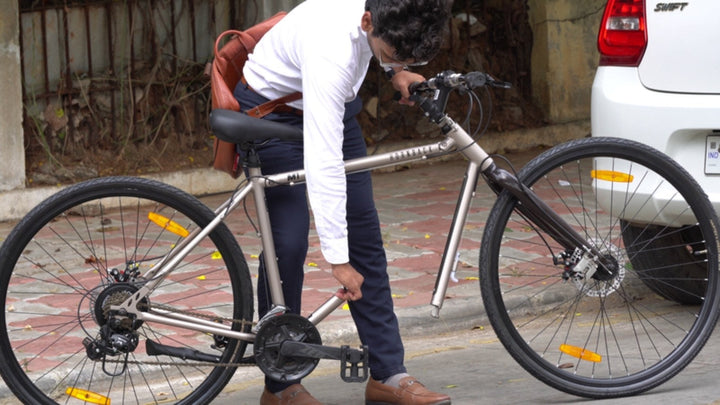
Hornback follows this modern approach. Its frames avoid single-member designs and instead use reinforced structures that prioritise rigidity after unfolding — which is critical for real city roads, flyovers, and rough patches.
Myth 2: “Non-Folding Bikes Are Always More Stable”
Fact:
Stability comes from geometry and wheel size, not from whether a bike folds.
What actually affects bicycle stability:
- wheel diameter
- wheelbase length
- head tube angle
- rider position
Many folding bikes feel unstable because they use small wheels to make folding easier. Smaller wheels react more sharply to potholes, speed changes, and steering inputs.
Very few brands attempt full-size wheels on folding bicycles, because it makes folding geometry and frame stiffness much harder to engineer.
Hornback is one of the rare brands that does. Models like Xpand, Xpand+, M1, and M1s use full-size wheels, which means:
- better pothole handling
- more predictable steering
- confidence at higher speeds
- ride feel closer to a traditional bicycle
This matters hugely in urban environments where roads are rarely smooth or consistent.
Myth 3: “Folding Bikes Are Only for Short Distances”
Fact:
Distance capability depends on comfort and fit, not folding.
A bicycle’s ability to handle longer distances depends on:
- saddle height and reach
- pedalling efficiency
- riding posture
- vibration absorption
Folding bicycles with compromised geometry are best suited for short rides. But full-size folding bicycles with proper proportions can comfortably handle daily commutes of 10–15 km or more.
Hornback’s range reflects this clearly:
- Xpand / Xpand+ → city commuting, flyovers, mixed urban roads
- M1 / M1s → riders who want mountain-bike posture, suspension, and control, but still need a bike that fits into apartment living
Myth 4: “Folding Bicycles Are Less Safe”
Fact:
Safety is more about maintenance, visibility, and riding conditions than frame type.
One often-ignored advantage of folding bicycles is indoor storage. Bikes kept indoors:
- corrode less
- have better brake performance
- are serviced more regularly
- suffer fewer surprise failures
In contrast, non-folding bicycles left outdoors are exposed to rain, dust, pollution, and theft-related damage.
A well-maintained folding bicycle can be safer in daily traffic than a neglected non-folding one.
Myth 5: “Non-Folding Bikes Last Longer”
Fact:
Longevity depends on exposure and care, not whether a bike folds.
Urban environments accelerate wear due to:
- humidity
- pollution
- temperature changes
Bicycles stored indoors — which folding bikes make easier — generally:
- last longer
- need fewer part replacements
- maintain consistent performance over years
This is a practical, real-world advantage, not a marketing claim.
Folding vs Non-Folding Bicycles in Urban Commutes
Non-Folding Bicycles Make Sense If:
- you have secure parking at home and work
- storage space isn’t an issue
- theft risk is low
They work well for predictable, single-mode commutes.
Folding Bicycles Make Sense If:
- you live in an apartment
- you combine cycling with metro, bus, or car
- parking security is uncertain
- you want cycling to fit seamlessly into daily life
Folding bicycles reduce friction — and reducing friction is what makes people cycle more often.
This is where modern folding bikes, especially full-size ones, change the equation entirely.
Folding vs Non-Folding: Practical Comparison
- Storage: Folding Bicycle – Fits indoors | Non-Folding Bicycle – Needs dedicated space
- Theft Risk: Folding Bicycle – Lower | Non-Folding Bicycle – Higher
- Ride Feel: Geometry-dependent for both
- Urban Practicality: Folding – High | Non-Folding – Medium
- Multi-Modal Commute: Folding – Excellent | Non-Folding – Limited
Neither is universally better. The right choice depends on how and where you live.
Where Modern Bicycle Design Is Heading
Across the cycling industry, brands are moving toward:
- rigid-bike ride quality in folding frames
- stronger, more precise locking mechanisms
- bicycles designed for daily urban use, not just weekend rides
Hornback fits into this shift by focusing on full-size folding bicycles that remove the traditional trade-off between portability and ride quality.
Final Thoughts
The debate between folding and non-folding bicycles isn’t about which is superior.
It’s about which one fits modern urban life.
Folding bicycles aren’t redefining cycling because they fold.
They’re redefining it because they make cycling easier to adopt, easier to store, and easier to sustain.