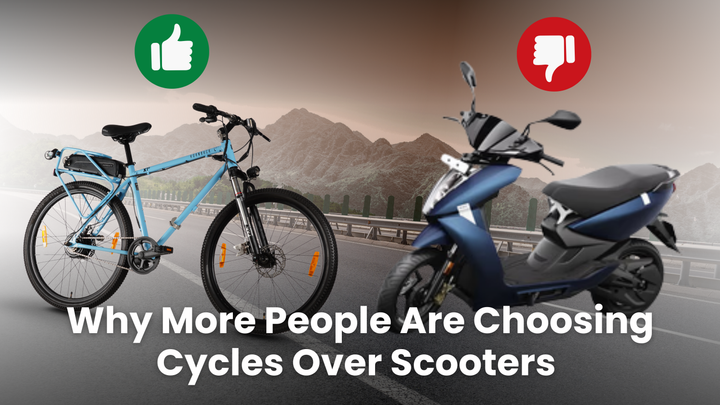
Why Young Professionals Prefer E-Bikes Over Scooters

1. The Cost War: Scooters vs E-Bikes (The Numbers That Hurt)
Young professionals aren’t ditching scooters because they want to “feel eco-friendly.”
They’re ditching them because scooters are burning holes in their wallets—and e-bikes aren’t.
Fuel vs Electricity (Actual Per-KM Cost in India 2025)
Expense Type
| Petrol Scooter | Electric Scooter | Electric Bicycle (E-Bike) |
| ₹2.5 – ₹3/km | ₹0.25 – ₹0.35/km | ₹0.06/km (yes, 6 paise) |
| ₹45 | ₹5 | ₹1 |
| ₹1,350 | ₹150 | ₹30 |
| ₹16,200 | ₹1,800 | ₹360 |
E-bike at full throttle = approx ₹1 of electricity for every 15 km.
This isn’t marketing talk. This is plain physics + average Indian electricity tariffs (~₹7/kWh) + typical e-bike battery efficiency.
Source:
CEA India Tariff Data
TERI EV Consumption Report
2. Maintenance Reality: The Hidden Money Drain
Scooters have a long list of recurring expenses:
- Engine oil
- Filters
- Belt
- Clutch
- Brake overhaul
- Periodic servicing
- Random breakdowns
Most scooter owners easily spend ₹5,000–₹8,000/year on maintenance.
E-bikes?
- Chain lube
- Tyre pressure check
- Brake pads once every 18–24 months
₹300–₹800/year. That’s it.
No engine.
No gearbox.
No oil changes.
No service bills that show up like jump-scares.
Even the battery, the most expensive part, lasts 3–5 years with proper care—and costs less than a year of scooter fuel.
3. Young Professionals Don’t Have Time for Drama
Between work, gym, and social life, nobody wants to:
- ❌ Stand in fuel queues
- ❌ Pay for parking
- ❌ Deal with service centers
- ❌ Navigate scooter traffic at 6 PM chaos hour
E-bikes remove all of that:
- Charge at home
- Park anywhere
- Ride in cycle lanes or side gaps
- Predictable commute time
- No license needed for most models
- No PUC, no insurance stress
- No registration drama
In cities like Bangalore, Pune, and Gurgaon, this convenience is honestly priceless.
4. Health + Commute = Big Win
Scooters = zero movement
E-bikes = assisted movement
Young professionals now prefer things that:
- Burn calories
- Reduce stress
- Improve sleep
- Boost productivity
- Fit into their fitness goals
Even with pedal assist, you move your body.
You gain strength without sweating buckets.
It’s “exercise in disguise”—exactly what busy people want.
Research Insight:
Cyclists who shift to e-bikes burn 70–80% of the calories of traditional cyclists, but with lower fatigue.
Source: Transportation Research Interdisciplinary Perspectives
5. Urban Infrastructure Now Favors E-Bikes
Cities are quietly upgrading:
- Cycle lanes
- Charging points
- No-parking zones for scooters
- Higher petrol taxes
- Reduced speed limits
- Metro + bike multimodal commuting
Young professionals are embracing this:
Metro → E-bike → Office
Gym → E-bike → Home
Work → Cafe → Co-working spaces
Parking a scooter is a headache.
Parking an e-bike = any corner is fine.
And if you use a full-size foldable e-bike like Hornback, it goes inside lifts, apartments, and office cabins without compromising on ride quality.
6. The Cultural Shift (The Part Nobody Talks About)
A decade ago:
Scooter = status, convenience, independence
Now:
Scooter = cost + traffic + maintenance headache
E-bike = smart, eco-friendly, gym-alternative, financially sensible
Young professionals care about:
- Minimalism
- Environmental impact
- Efficiency
- Flexible commuting
- Zero stress mobility
E-bikes fit perfectly into this mindset.
7. Subtle But Serious: Hornback’s Angle
This isn’t a sales pitch — just an observation:
Most people switching to e-bikes want convenience without compromises.
Hornback gives that by offering:
- Full-size riding feel (unlike tiny-frame foldables)
- Diamond-frame stability
- Foldable portability
- Proper MTB geometry for city bumps
- Battery + mechanical reliability backed by warranty
So young professionals get:
- Scooter convenience
- Bicycle health benefits
- Zero parking problems
- Full-size comfort
E-bikes often feel like “compromise cycles.”
Hornback doesn’t.
Final Thoughts
Young professionals aren’t switching from scooters to e-bikes out of trendiness.
They’re switching because it just makes sense.
- Costs 95% less to run
- Zero maintenance stress
- Fitness built into your daily routine
- No fuel volatility
- No parking frustration
- No license or paperwork
- Predictable commute times
- Cleaner, quieter, mentally lighter
For short-to-medium city commutes (3–20 km), an e-bike simply wins.
Every. Single. Time.