Why Electric Cycles Are Becoming the Most Practical Form of Urban Transport

1. Most Urban Travel Is Short — and Poorly Served by Conventional Vehicles
Multiple global studies confirm that the majority of urban trips are under 10 km, with a large share under 5 km. These trips include commuting to work, reaching public transport, running errands, or visiting nearby social spaces.
Despite this, people often rely on:
- cars
- scooters
- ride-hailing services
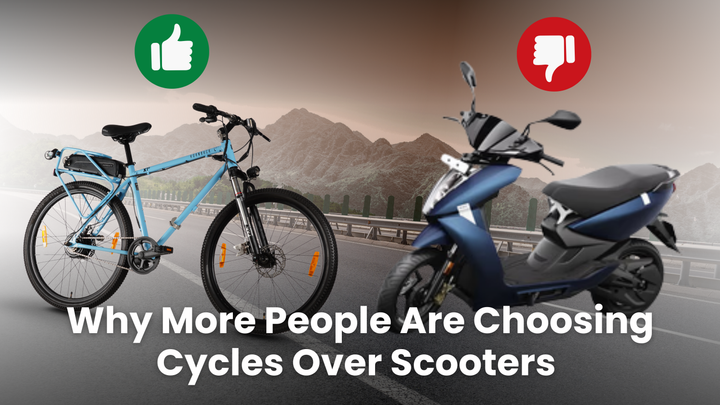
These vehicles are optimized for longer distances, not frequent short trips. They consume more energy than necessary, require parking space, and increase congestion for distances where speed advantages barely exist.
According to the World Bank, short-distance motorized trips are among the biggest contributors to congestion and energy waste in cities.
Electric cycles fill this gap precisely. They are designed for short, frequent, stop-start movement, making them far more efficient for everyday urban travel.
2. Energy Efficiency: The Hidden Advantage That Actually Matters
Transport efficiency is best measured not by speed, but by energy consumed per passenger-kilometre.
Approximate energy usage:
- Electric cycle: 100–150 watts
- Petrol scooter: 2,000–4,000 watts
- Car: 15,000 watts or more
This difference is not marginal—it is exponential.
The International Energy Agency (IEA) identifies micromobility, including electric bicycles, as one of the most energy-efficient transport solutions available today.
Lower energy use translates directly into:
- lower operating costs
- reduced emissions
- less strain on city infrastructure
This is why the real electric cycle benefit is not just environmental—it is systemic.
3. Cost of Ownership: Why Electric Cycles Make Economic Sense
When people compare vehicles, they often focus on purchase price. What matters more is total cost of ownership.
Electric cycles typically incur:
- negligible charging costs
- minimal servicing
- no fuel dependency
- lower part wear
Studies by the International Council on Clean Transportation (ICCT) show that micromobility vehicles have the lowest cost per kilometre for urban trips.
For daily commuters, this means predictable expenses and insulation from fuel price fluctuations—something conventional vehicles cannot offer.
4. Health Benefits Without the Barriers of Traditional Exercise
Electric cycles still require pedalling. The motor assists effort—it does not eliminate movement.
This creates a form of moderate, consistent physical activity, which public-health research identifies as the most sustainable type of exercise.
A large study published in the British Medical Journal (BMJ) found that people who cycle for transport have significantly lower risks of cardiovascular disease and all-cause mortality.
Electric assistance increases participation by:
- reducing joint strain
- lowering fatigue
- making longer rides achievable
As a result, total physical activity often increases, rather than decreases.
5. Mental Health and the Psychology of Commuting
Commutes are not just physical journeys—they are cognitive experiences.
Research consistently links long, unpredictable commutes with:
- increased stress
- reduced productivity
- poorer mental health
Active commuting methods, including cycling, are associated with better mood and lower anxiety levels, according to The Lancet Public Health.
Electric cycles reduce mental load by offering:
- predictable travel times
- fewer interruptions
- a sense of control over movement
This psychological benefit is often overlooked—but deeply felt by daily riders.
6. Why Practical Design Determines Long-Term Adoption
Many transport solutions fail not because they perform poorly, but because they don’t fit into daily life.
Vehicles that require:
- outdoor parking
- complex maintenance
- exposure to weather
are used less consistently over time.
Foldable electric cycles address this by allowing indoor storage, easier cleaning, and better protection from environmental wear. This design philosophy aligns with what urban mobility research identifies as a key adoption factor: reduced friction.
Brands like Hornback focus on this integration—building electric cycles that ride like full-size bicycles but store like compact ones. This isn’t about features; it’s about behavior.
7. Why Cities Are Quietly Shifting Toward Micromobility
Urban planning bodies are increasingly prioritizing:
- smaller vehicles
- mixed-use streets
- reduced car dependency
The OECD and International Transport Forum emphasize cycling and micromobility as central to future urban transport systems.
Electric cycles support this shift without demanding massive infrastructure changes— making them scalable and immediately effective.
Final Thoughts
Electric cycles succeed not because they are faster than cars or more powerful than scooters, but because they are right-sized for real urban life.
They align with:
- short trip patterns
- human energy levels
- economic realities
- environmental limits
As cities search for practical mobility solutions, electric cycles are emerging not as alternatives—but as essentials.