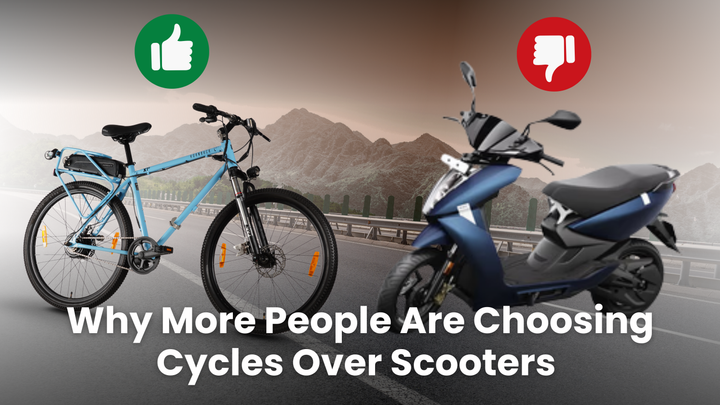
Why Short-Distance Mobility Matters More Than High-Speed Transport

The Case for Electric Cycles in Short-Distance Urban Mobility
Multiple global studies show that over 50–60% of daily urban trips are under 10 km, and a significant portion are under 5 km.
Yet these trips are often made using:
- cars
- scooters
- congested buses
- ride-hailing vehicles
This creates unnecessary congestion and energy waste for distances that don’t need heavy infrastructure.
1. Most Urban Trips Are Short — Much Shorter Than We Think
Urban mobility data consistently shows that cities are overwhelmed not by long journeys, but by repeated short trips that accumulate congestion and inefficiency.
These short trips are the hardest to optimise with cars or buses, yet the easiest to solve with lighter, more flexible transport.
2. Speed Isn’t the Bottleneck — Transitions Are
Urban travel time is dominated by:
- parking searches
- traffic signals
- acceleration and braking
- congestion spillovers
Research from MIT’s Senseable City Lab shows that average door-to-door speeds in dense cities are remarkably similar across cars, scooters, and buses — often below 20 km/h.
The inefficiency isn’t how fast vehicles can go — it’s how poorly they handle frequent transitions.
Electric cycles reduce transition friction by:
- eliminating parking delays
- maintaining steady movement
- requiring minimal acceleration effort
- integrating well with mixed infrastructure
3. Infrastructure Works Best with Small, Lightweight Vehicles
Urban transport research increasingly favours low-mass mobility due to:
- lower road wear
- lower energy use
- lower space consumption
- lower injury risk
According to international transport studies, cities that promote bicycles and electric cycles see reduced congestion, improved safety, and better land-use efficiency.
Electric cycles sit at a critical intersection:
- human-powered
- electrically assisted
- infrastructure-light
They don’t require new highways — just better utilisation of existing streets.
4. Health Benefits Go Beyond Exercise
Unlike recreational cycling, transport cycling creates consistent, moderate physical activity — the kind most strongly linked to long-term health benefits.
Large cohort studies show that people who cycle for transport have significantly lower risks of:
- cardiovascular disease
- all-cause mortality
- metabolic disorders
Electric assistance doesn’t remove these benefits. Instead, it:
- increases participation
- extends ride duration
- reduces drop-off due to fatigue
This leads to more total physical activity, not less.
5. Energy Efficiency: Orders of Magnitude Matter
Approximate energy use comparisons:
- Electric cycle: 100–150 watts
- Scooter or motorbike: 2,000–4,000 watts
- Car: 15,000+ watts
Micromobility ranks among the most energy-efficient transport solutions per passenger-kilometre.
When cities scale short-distance electric mobility, energy savings multiply rapidly — without waiting for large infrastructure projects.
6. Design Determines Adoption
Transport research consistently shows that ease of use matters more than performance metrics.
People adopt vehicles that are:
- easy to store
- easy to access
- easy to maintain
- easy to integrate into daily routines
This is where foldable electric cycles have a structural advantage. Being able to store a cycle indoors, carry it into offices, or combine it with public transport reduces adoption barriers.
Brands like Hornback focus on this usability layer — not just ride quality, but how the cycle fits into real homes and workplaces.
7. Why Cities Are Shifting Focus Quietly
Urban transport policy is shifting from asking:
How do we move people faster?
To:
How do we reduce the need for inefficient trips?
Electric cycles support this shift by:
- decentralising mobility
- reducing short-trip congestion
- improving neighbourhood accessibility
The UN Environment Programme identifies micromobility as a key lever for sustainable urban development.
Final Thoughts
The future of urban mobility won’t be defined by faster vehicles — but by smarter short-distance movement.
Electric cycles solve a problem most cities overlook: everyday trips that are too short for heavy transport, yet too frequent to ignore.
When these trips become efficient, cities breathe easier — literally and figuratively.
And when cycles are designed to integrate smoothly into daily life — storing indoors, folding neatly, charging simply — adoption becomes natural.
Short-distance mobility isn’t a side problem.
It’s the main one we’ve been missing.